
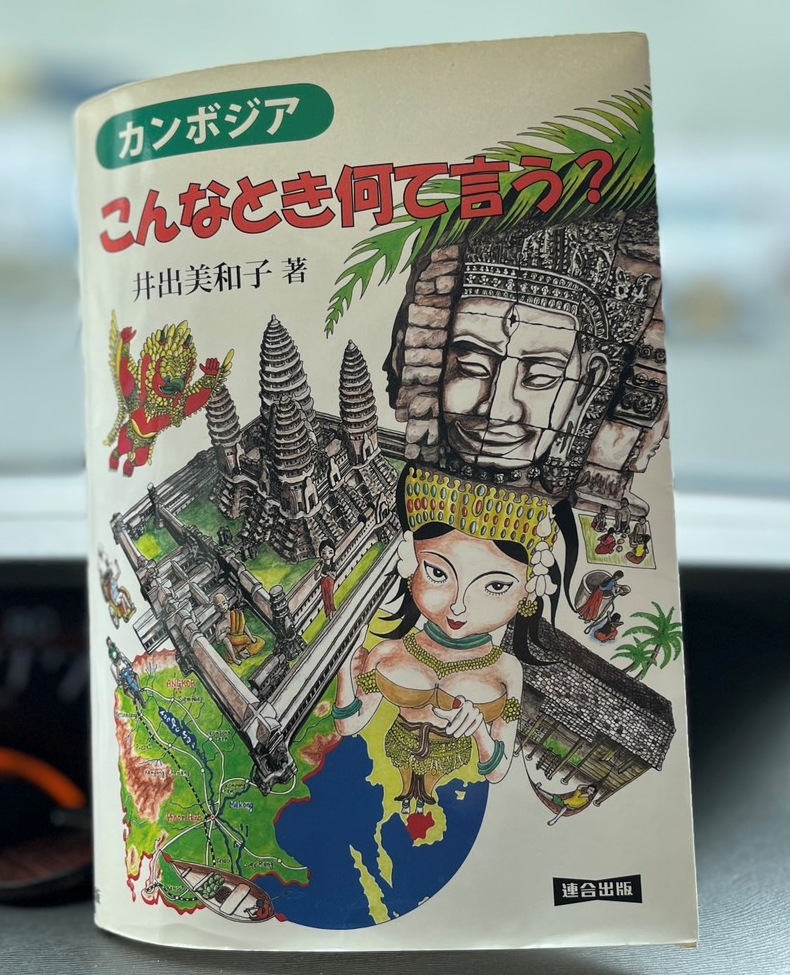
Good evening. I am Katsuya Yasuda from the Cambodia Bicycle Project.
Today, I would like to introduce a study book on the Cambodian language, Khmer.
Cambodia: What Do You Say in Such Situations? by Miwako Ide (Rengo Publishing)
I bought this book in October 2023. That means it took me nearly two years to finish reading it.
I originally purchased it on Mercari as part of my Khmer language studies. When I first picked it up, I must admit I was a little puzzled. The pronunciation was written entirely in katakana. Since I wanted to study the script itself, my first impression was slightly disappointing: “If only Khmer characters had been included as well…” That is also why it took me so long to finish—after reading about ten pages, I put it away on the shelf for quite some time.
However, about a month ago, it caught my eye again on the bookshelf, and I decided to give it another try. As I continued reading, my impression of the book completely changed. It turned out not to be just a phrasebook, but rather a lively collection of the author’s experiences and daily life during her stay in Cambodia. It read almost like an essay, full of enjoyable anecdotes. Scenes of shopping in the market, casual conversations with locals, and cultural or customary episodes—each phrase was introduced with concrete, real-life situations that made it easy to picture the setting in my mind. I often found myself thinking, “I’d like to use this phrase if I were in that situation.”
Since I am already studying Khmer, seeing familiar words written in katakana gave me a strange sense of closeness. Many expressions overlapped with what I had heard in honest conversations with Cambodians, and I often thought, “Ah, so this is how I should say it.” At the same time, I encountered many words and phrases that were entirely new to me. I had assumed it was just a simple conversation guide, but in reality, it was filled with discoveries. The initial concern I had—“Without the script, this book might feel lacking”—was replaced by the realization, “In the end, this turned out to be a handy study resource.”
I believe the actual value of this book lies not only in introducing words but also in allowing readers to feel the “living Khmer language” through the author’s real experiences. Of course, studying grammar and script at a desk is essential, but learning words alongside the atmosphere of the country and the expressions of its people helps us understand the culture more deeply. For me, this book became both a language reference and a window that brought Cambodia much closer to my everyday life.
If you are interested in Khmer, or if you would like to know more about life and culture in Cambodia, this book is an excellent place to start. It goes beyond the boundaries of a language-learning text and can also be enjoyed as an essay. I highly recommend it not only to beginners of the language but also to anyone with an interest in Cambodia!